

If you have ever owned a puppy or spent time throwing a ball in the backyard, you have likely wondered what the world looks like through their eyes. Do they see the vibrant green of the grass? Can they appreciate the bright red of their favorite chew toy? For decades, a persistent myth dictated that dogs lived their entire lives in a dull, black-and-white movie.
- The Science of the Canine Eye: Rods vs. Cones
- What Is Color Blindness in Puppies? (Dichromatic Vision)
- The Dog Color Spectrum: What Do They Actually See?
- Why Does Color Vision Matter for Puppies?
- Do Certain Breeds Have Better Color Vision?
- The Canine Visual Superpowers: Where Dogs Beat Humans
- Puppy Eye Development: When Do They See Clearly?
- Conclusion: A Beautiful, Different Perspective
- Frequently Asked Questions (FAQ)
- References
Today, thanks to advancements in veterinary ophthalmology, we know that this old wives’ tale is entirely false. So, are puppies color blind? The answer is a resounding “yes and no.” They do suffer from a specific type of color blindness compared to humans, but their world is far from grayscale. They see a unique, specialized spectrum of colors that perfectly suits their evolutionary needs as hunters and scavengers.
In this comprehensive guide, we will explore the fascinating science behind a puppy’s vision, exactly what colors they can and cannot see, and how you can use this knowledge to improve their training, playtime, and overall quality of life.
The Science of the Canine Eye: Rods vs. Cones
To understand what it means to be “color blind,” we must first look at the biological anatomy of the eye. In both humans and dogs, the retina (the light-sensitive layer at the back of the eye) contains two main types of photoreceptor cells: rods and cones.
- Cones are responsible for detecting color and fine, detailed central vision. They require bright light to function properly.
- Rods are responsible for detecting light levels (night vision) and tracking motion. They do not process color.
According to the American Kennel Club (AKC), the fundamental difference between human and dog vision lies in the ratio of these cells. Humans have a high concentration of cones, allowing us to see a vibrant, detailed rainbow of colors. Dogs, however, have a much lower concentration of cones and a vastly higher concentration of rods.
What Is Color Blindness in Puppies? (Dichromatic Vision)
When we say a puppy is “color blind,” we do not mean they see only in black, white, and shades of gray. Instead, they experience a specific type of color blindness similar to red-green color blindness in humans.
Human eyes possess three distinct types of cones, which allow us to perceive red, blue, and green light. This is called trichromatic vision. By combining these three primary colors, humans can see roughly one million different shades.
Dogs, on the other hand, only have two types of cones in their retinas. This is known as dichromatic vision. Their two cones are tuned to perceive blue and yellow light. Because they lack the third cone responsible for processing red and green light, those specific colors do not register in their brains the same way they do in ours.
The Dog Color Spectrum: What Do They Actually See?
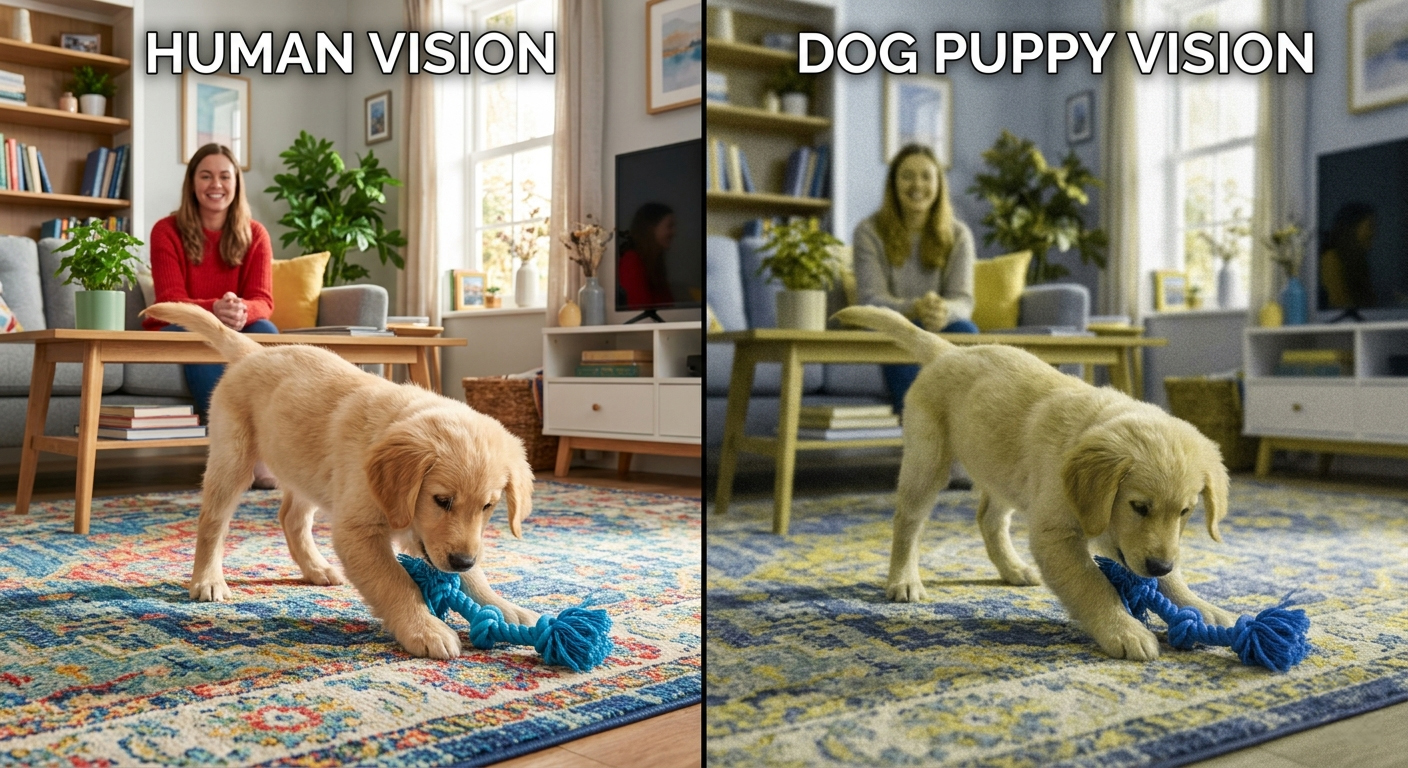
If a puppy cannot see red or green, what does their world actually look like? Veterinary researchers, including those at VCA Animal Hospitals, have mapped out the canine color spectrum. Here is exactly how your dog perceives common colors:
| The Color (To a Human) | How It Appears (To a Dog) |
|---|---|
| Red | Dark brownish-gray or black. |
| Orange / Green | Various shades of yellowish-gray or mustard. |
| Yellow | Bright, distinct yellow. |
| Blue | Bright, distinct blue. |
| Purple / Violet | Standard blue. |
The “Red Ball on Green Grass” Dilemma
This scientific reality creates a hilarious irony in the pet industry. For decades, pet product manufacturers have produced bright red and neon orange tennis balls, assuming they would be highly visible to dogs. In reality, red and orange are the worst colors for a dog toy.
When you throw a bright red ball onto a lush green lawn, human eyes easily spot the vibrant contrast. To your puppy, however, the red ball looks dark muddy-brown, and the green grass looks yellowish-gray. The ball virtually camouflages into the grass! When your dog finally finds the ball, they are relying almost entirely on their incredible sense of smell and their ability to track the motion of the bouncing object, not its color.
Why Does Color Vision Matter for Puppies?
While color blindness in puppies may seem like a disadvantage to us, it is important to remember that their vision is perfectly adapted for their survival. Understanding a puppy’s color vision allows you to make smarter, more empathetic choices as an owner.
1. Choosing the Best Toys and Training Gear
If you want to buy a toy that your dog will easily see and get excited about, stop buying red, orange, or green items. Instead, fill their toy box with blue and yellow toys. A bright blue frisbee against a green (yellowish-gray to the dog) sky or grass will pop with incredible contrast, making it much easier for your dog to track and catch.
This is also why professional dog agility courses rely heavily on blue and yellow equipment. The tunnels, weave poles, and jumps are painted in these specific colors so the dogs can easily distinguish the obstacles while running at top speed.
2. Understanding Frustration During Training
If you are trying to teach your puppy to retrieve a specific object, or if you use colored targets during obedience training, using the wrong colors can lead to unnecessary frustration. If your dog consistently fails to find a red dumbbell in the grass, they are not being stubborn or unintelligent—they literally cannot see it clearly.
Do Certain Breeds Have Better Color Vision?
A common misconception floating around dog parks is that certain breeds, such as Australian Shepherds or Siberian Huskies (perhaps due to their striking blue eyes), possess superior color vision compared to other breeds.
We must gently correct this myth. The biological makeup of the canine retina is consistent across the entire species. Whether you own a tiny Chihuahua or a massive Great Dane, all dogs have the exact same two-cone dichromatic vision. They all see the same blue-yellow spectrum.
However, what does change between breeds is their field of vision and their visual acuity (sharpness). Sighthounds, like Greyhounds and Salukis, have longer snouts and eyes placed further apart on their skulls, giving them a remarkable 270-degree field of vision. Brachycephalic (flat-faced) breeds like Pugs have a narrower field of vision. So, while a Greyhound might spot a rabbit running far in the distance faster than a Pug, both dogs will still see that rabbit in the same shades of blue and yellow.
The Canine Visual Superpowers: Where Dogs Beat Humans
While humans easily win the contest for color perception and fine detail, dogs possess several visual “superpowers” that leave human eyesight in the dust.
1. Incredible Night Vision
Remember those rods we mentioned earlier? Dogs have significantly more rods in their eyes than humans do. This allows them to see in light levels that are five times dimmer than what a human requires. Furthermore, dogs possess a special reflective membrane behind their retina called the tapetum lucidum.
According to the American Veterinary Medical Association (AVMA), this membrane acts like a mirror, bouncing light back through the retina a second time, essentially giving the photoreceptors two chances to process the light. This is why your dog’s eyes glow with an eerie green or yellow reflection when caught in a flashlight beam or headlights at night.
2. Unmatched Motion Detection
Because they are evolutionary predators, a dog’s eyes are heavily optimized to detect motion. A dog might not be able to see the fine details of a squirrel sitting perfectly still in a bush, but the millisecond that squirrel twitches, the dog’s high concentration of rod cells instantly flags the movement. Dogs can detect subtle movements from incredible distances, far beyond human capabilities.
3. A Wider Worldview
Human eyes face straight forward, giving us roughly a 180-degree field of vision. Most dogs have eyes set at a slight angle, giving them a field of vision of around 240 to 250 degrees. This means your puppy can see objects approaching from their peripheral vision much sooner than you can.
Puppy Eye Development: When Do They See Clearly?
If you have a newborn puppy, their vision is vastly different from an adult dog. Puppies are born completely blind, with their eyelids tightly sealed shut to protect their developing optic nerves.
Around 10 to 14 days of age, their eyes finally begin to open. However, their vision is extremely blurry, and their retinas are not yet fully developed. They cannot process colors or focus on distant objects. It takes several weeks for their tapetum lucidum to fully form and for their photoreceptors to mature. By the time a puppy is roughly 8 weeks old, their vision (including their dichromatic blue-yellow color spectrum) is fully developed and functioning like an adult dog’s.
Conclusion: A Beautiful, Different Perspective
So, are puppies color blind? By human standards, yes, they are red-green color blind. But they do not live in a sad, black-and-white world. Your puppy sees a beautiful, tailored spectrum of vibrant blues, stark yellows, and highly contrasted grays.
Nature designed the canine eye perfectly for their needs. They traded the ability to see a ripe red apple for the ability to hunt gracefully in the dark, track the slightest motion in the brush, and perceive a wider panoramic view of their surroundings. As a pet owner, understanding how your dog sees the world allows you to enrich their life, whether that means buying a bright blue tennis ball, designing an easy-to-see agility course, or simply appreciating the unique, beautiful way your furry best friend looks back at you.
Frequently Asked Questions (FAQ)
What is the best color toy to buy for a puppy?
The absolute best toy colors for dogs are bright blue and bright yellow. Because dogs have dichromatic vision, these are the colors that stand out the most vibrantly against duller backgrounds like grass, dirt, and carpets.
Can dogs watch and understand TV?
Yes! With the advent of high-definition, high-refresh-rate televisions, many dogs can actually see the images on the screen. Because their eyes process motion faster than ours (they need a higher “flicker fusion rate”), old CRT televisions just looked like rapidly flashing lights to dogs. Modern LED TVs allow them to see the picture clearly. There is even specific programming (like DogTV) color-graded specifically for a dog’s blue-yellow vision!
How do I know if my puppy has actual vision problems?
While color blindness is normal, true vision loss is not. If your puppy frequently bumps into furniture, hesitates to jump off the couch or walk down stairs, has cloudy or hazy-looking pupils, or paws constantly at their eyes, you should schedule a veterinary examination immediately to rule out congenital cataracts or glaucoma.
Can dogs see in total darkness?
No animal can see in absolute, pitch-black darkness. However, because of their high rod count and the reflective tapetum lucidum in their eyes, dogs can see incredibly well in very low-light conditions, such as starlight or the faint glow of a streetlamp, where humans would be completely blind.
References
- American Kennel Club (AKC). Are Dogs Color Blind? AKC.org
- VCA Animal Hospitals. Do Dogs See Color? VCAHospitals.com
- American Veterinary Medical Association (AVMA). Canine Vision and Eye Health AVMA.org